Braised Ox Cheeks
Slow-braised ox cheeks in red wine until fork-tender — pure comfort food royalty.
Prep: 30 min · Cook: 4 hrs · Total: 4 hrs 30 min · Serves: 4 · Difficulty: Hard · Rating: 5/5 (615 reviews)
INSPIRED BY
Featured on Diners, Drive-Ins & Dives
From DDD's recipe collection — ox cheeks are the ultimate low-and-slow cut, transforming from tough to impossibly tender and silky.
Story
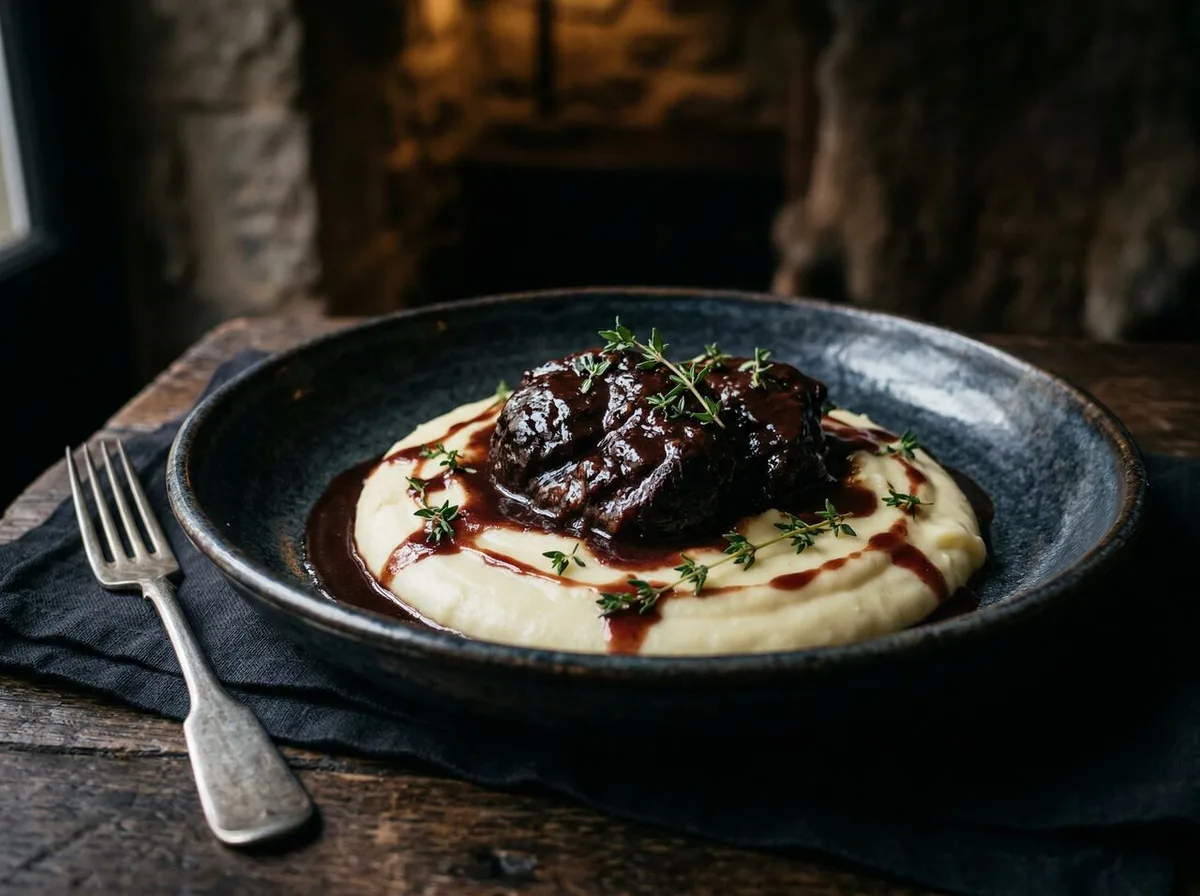
Ask a butcher for ox cheeks in most American shops and you'll get a blank stare, because here we call them beef cheeks and most counters don't bother to carry them, which is a shame and an opportunity. I had them the first time in a gastropub kitchen where the chef let me stand by the pass, two dark glossy lobes sitting in a reduced wine sauce over polenta, and the meat gave way like the inside of a baked potato. The cut does almost all the work. You just have to not get in its way. Here's the thing nobody tells you about cheeks: they are pure working muscle, threaded with connective tissue, which is exactly why they're cheap and exactly why they turn silky when you braise them long enough. People hear 'tough cut' and panic and pull them out of the oven at two hours when they're still chewy. Cheeks want three and a half to four hours at 300 degrees. Done is when a fork meets zero resistance. There is no shortcut and there is no harm in going longer. The technique that separates good from forgettable is the sear and the reduction. Pat the cheeks bone dry and sear them until they're genuinely dark, not gray, because that crust is flavor. Then caramelize the onions and carrots, cook the tomato paste until it turns brick-colored and loses its tinny edge, and reduce the wine by half so it stops tasting sharp. At the end, strain the braising liquid and reduce it hard until it coats a spoon and goes glossy. That sauce is the payoff for four hours of patience. Spoon it over mashed potatoes or polenta and don't apologize for how rich it is. Richness is the point of a cheek. A heavy Dutch oven with a tight lid is the right vessel, because you want the moisture to stay trapped and the heat gentle and even; a thin pot scorches the bottom and a loose lid lets it all dry out. Use a wine you'd actually drink, a Cabernet or a Malbec with some structure, because the flavor concentrates as it reduces and a thin, sour wine concentrates into thin, sour sauce. Two cheeks feed four people generously, and they reheat better the next day than almost anything, the flavors having married overnight in the fridge. Serve over something soft and starchy that can carry the sauce. Mashed potatoes, polenta, even buttered noodles. The sauce is the star and it needs a stage.
By Theo
Ingredients
- 4 ox cheeks (about 2 lbs)
- 1 bottle red wine (Cabernet or Malbec)
- 2 cups beef broth
- 2 onions, quartered
- 3 carrots, chunked
- 4 cloves garlic
- 2 tbsp tomato paste
- 3 sprigs thyme
- 2 bay leaves
- Mashed potatoes or polenta for serving
Instructions
- Pat ox cheeks dry. Season with salt and pepper. Sear in a hot Dutch oven until deeply browned on all sides.
- Remove cheeks. Sauté onions and carrots until caramelized, about 10 minutes.
- Add garlic and tomato paste, cook 2 minutes until paste darkens.
- Deglaze with red wine. Scrape up every bit of fond. Reduce by half.
- Return ox cheeks, add broth, thyme, and bay leaves. Bring to a simmer. Cover and braise at 300°F for 3.5-4 hours.
- The cheeks are done when they yield to a fork with zero resistance. Strain and reduce the braising liquid. Serve over creamy mashed potatoes.
Chef Tips
- Ox cheeks need time — don't rush them. The collagen breakdown happens around the 3-hour mark, and that's when they go from tough to transcendent. The braising liquid becomes an incredibly rich, naturally thickened sauce.
Cook's Notes
- **Ox cheek substitute:** Beef cheeks from the butcher are the same cut. If unavailable, short ribs (bone-in) are the closest in fat-to-muscle ratio and braising behavior.
- **Wine substitute:** Non-alcoholic: use 1 cup beef broth plus 1 tbsp red wine vinegar plus 1 tsp Worcestershire per cup of wine. The vinegar replaces acidity.
- **Make-ahead:** Ox cheeks are better the next day. Braise fully, cool in the liquid, refrigerate overnight. Reheat gently in the braising liquid. Skim the solidified fat cap before reheating.
- **Storage:** Fridge 4 days in the braising liquid. Freezer 3 months. Thaw overnight in fridge.
- **Equipment:** A Dutch oven or heavy oven-safe pot with a tight-fitting lid is essential. The tight seal traps steam and keeps the braise moist without basting.
- **Common mistake:** Lifting the lid frequently during braising. Every peek drops the internal temperature by 10-15°F and adds 15+ minutes to the cook time.
- **Doneness cue:** The cheeks should yield to fork pressure with zero resistance — they'll look like they're about to fall apart but still hold their shape. If there's any spring-back, give them another 30 minutes.